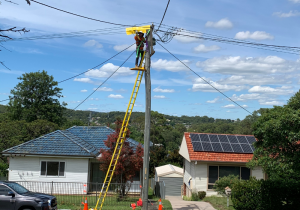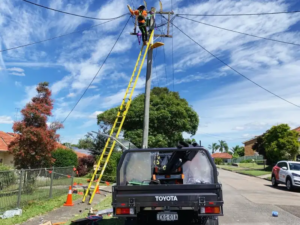

When managing a property in Newcastle or Lake Macquarie, electrical infrastructure is often out of sight—until it becomes a problem. Private power pole installation Newcastle are most commonly required when an existing overhead supply no longer complies with current NSW or Ausgrid requirements, or when new development conditions demand a compliant point of connection. This guide explains the private power pole installation process in Newcastle, including how works are staged, what compliance is required, and why a Level 2 ASP is mandatory.
Typical reasons a private power pole is required include:
- Existing overhead mains encroaching on a neighbouring property (not permitted under NSW rules)
- Inadequate overhead clearance across roads or driveways
- New builds with no compliant point of attachment
- Battle-axe blocks where cable spans exceed allowable limits
- Ausgrid defect notices issued for corrosion, leaning, or structural failure
All works described below are carried out by Level 2 Accredited Service Providers (ASP) in accordance with:
- AS/NZS 3000:2018
- NSW Service & Installation Rules (2019)
- Ausgrid Electrical Standards
If you’re looking for pricing or defect rectification, see our Level 2 ASP services in Newcastle. Level 2 ASP Services Newcastle
What Is a Private Power Pole
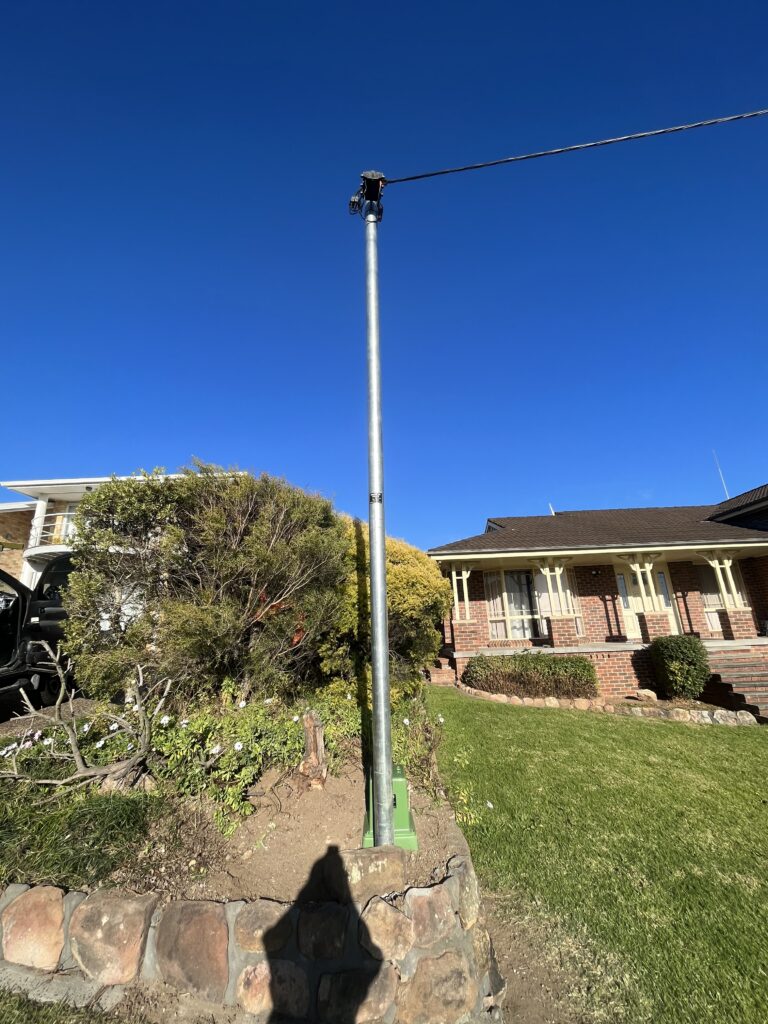
A private power pole is a customer-owned structure installed within 1 meter of your property’s front boundary. It serves as the Point of Attachment (POA) for overhead service mains coming from the Ausgrid network and supports the transition to your property’s consumer mains.
Once the supply crosses the property boundary, the pole and all associated infrastructure become the property owner’s legal responsibility.
Private vs Public Power Poles in NSW
Public Power Poles
- Located in the street or road reserve
- Owned and maintained by Ausgrid
Private Power Poles
- Located inside your property boundary
- Owned and maintained by the property owner
- Subject to inspection by Ausgrid
If a private pole is found to be unsafe—due to corrosion, structural movement, or age—Ausgrid may issue a Defect Notice requiring rectification within a specified timeframe to avoid disconnection.
Why a Level 2 ASP Is Required
Standard electrical contractors are licensed to work after the main switch only. They are not authorised to work on service mains, points of attachment, or network-connected infrastructure.
A Level 2 Accredited Service Provider (ASP) is legally required because private power pole works involve:
- Disconnecting and reconnecting live network service mains
- Installing or modifying points of attachment
- Installing overhead or underground consumer mains
- Coordinating metering and network paperwork
- Lodging mandatory NOSW and CCEW documentation
Only a Level 2 ASP can legally certify the work and restore supply.
If you are planning a private power pole installation in Newcastle, engaging a compliant Level 2 ASP from the outset prevents delays, defects, and unnecessary rework.
Private Power Pole Installation Newcastle
Private power pole installations in Newcastle are almost always completed over two site visits. This is deliberate and required for structural integrity and compliance.
Stage 1: Site Assessment & Preparation (No Power Interruption)
Before any excavation begins, a full site assessment is completed to confirm:
- Property boundaries (plans, pegs, or SIX Maps)
- Overhead clearance requirements
- Underground services via Dial Before You Dig
- Soil conditions affecting embedment depth
The pole location is set to comply with NSW Service Rules and Ausgrid clearance requirements from the outset.
Stage 2: Pole Installation
A galvanised private steel power pole is installed, typically 6.5 m or 7.2 m tall, depending on overhead clearance.
This includes:
- Excavation to the correct depth
- Installation of conduit and cable access points
- Setting the pole plumb and level
- Concreting to engineered depth
The pole is left to cure for two or three days.
No mechanical load or service connection is applied during this period.
This step is critical. Rushing this process is one of the most common causes of new poles being installed, and they are already leaning.
Stage 3: Consumer Mains Installation
Once the concrete foundation of the new pole has cured, we install the consumer mains. These are the conductors that run from the connection point on your private pole to the main switchboard (meter box).
There are two primary methods for this installation:
• Underground Consumer Mains (Preferred): This is the modern standard for most Newcastle property upgrades. We install XLPE-insulated, PVC-sheathed cables within heavy-duty conduits buried at a minimum depth of 500mm. Undergrounding the supply significantly improves reliability by removing risks associated with storm damage and vegetation interference.
• Overhead (Aerial) Consumer Mains: In specific scenarios where ground conditions or site obstacles make trenching impractical, aerial consumer mains may be used. These must be installed with strict adherence to height and clearance requirements to remain compliant with AS/NZS 3000.
Stage 4: Final Connection & Changeover (Planned Outage)
On the second visit, a planned power interruption is scheduled—typically 6 to 8 hours.
Works completed during this stage include:
- Disconnection of existing overhead service mains
- Connection of the new service and the consumer mains
- Meter coordination (if required for the project scope)
- Testing, commissioning, and energisation
Not all jobs require meter replacement, but all jobs require NOSW and CCEW lodgement.
Stage 5: Testing, Certification & Compliance
Before supply is restored, full testing is completed, including:
- Polarity
- Insulation resistance
- Earthing verification
- Phase rotation
- NST Test
- Neutral integrity test
- Visual and mechanical inspection
Compliance documentation is lodged with Ausgrid and NSW Fair Trading, ensuring the installation is inspection-ready and legally certified.
Why We Primarily Install Steel Private Poles
In Newcastle and Lake Macquarie, the most popular poles are the galvanised steel poles. They are the preferred option because they:
- Are cost-effective for most residential installs
- Have a slim, modern appearance
- Are resistant to termites
- Provide a typical service life of 20–30 years in local conditions
When Timber Poles Are Used
Timber poles are still specified in certain situations.
- Larger diameter and higher bending strength
- Used where additional height or structural capacity is required
- Common in rural or high-load applications
- Subject to termite and ground-line decay over time
Titan Composite Poles
Composite poles are used in high-corrosion environments.
- Excellent resistance to ground-line corrosion
- Suitable for coastal and aggressive soil conditions
- Higher material cost than steel or timber
- Used where long-term durability is prioritised
Pole selection is always based on clearance, lifespan, site conditions, and compliance, not aesthetics alone.
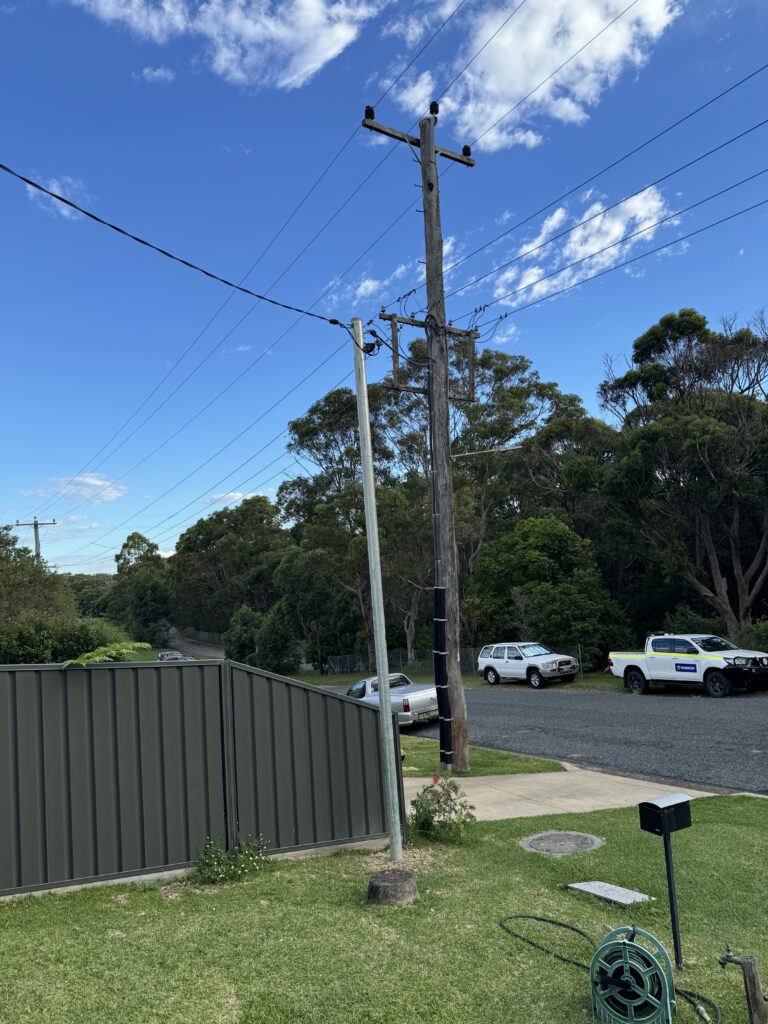
Why Correct Installation Matters
Private power pole installations must meet strict structural, clearance, and boundary requirements at the time of installation. When these details are missed, or shortcuts are taken, issues may not appear immediately — but they often surface later during routine network inspections or property changes.
Common problems that arise from poor or outdated installations include:
- Base corrosion on steel poles due to inadequate protection or unsuitable materials for coastal conditions
- Internal decay or termite damage in older timber poles
- Insufficient overhead clearances caused by incorrect pole height or conductor sag
- Encroachment beyond property boundaries, where service lines cross neighbouring land without an easement
- Pole movement or lean resulting from shallow embedment or inadequate footing design
A correctly designed and installed private pole, completed in accordance with the NSW Service & Installation Rules and AS/NZS 3000, significantly reduces the risk of future compliance issues and unplanned rectification works
Is a Private Power Pole Always Required?
Not always.
In some situations, an underground-only supply upgrade can remove the need for a private power pole altogether. Where an Ausgrid network pole is located on the footpath or road reserve, an Underground to Overhead (UGOH) connection may be used, allowing the service to run underground to the property and connect at the network pole — fully eliminating visible overhead cables on the private side.
In other cases, an existing private pole may simply require replacement or relocation, rather than a full redesign of the supply.
Whether a private pole is required depends on several site-specific factors, including:
- Network configuration at the street
- Allowable span lengths from the network pole
- Property boundary constraints
- Minimum clearance requirements
- Condition and compliance of existing infrastructure
Because these factors vary from site to site, a site-specific assessment by a Level 2 Accredited Service Provider is essential before determining the correct supply arrangement.
What Affects the Cost of a Private Power Pole Installation?
The cost of a private power pole installation in Newcastle varies from site to site. There is no flat rate because each installation must be designed around compliance, access, and ground conditions.
Key factors that influence cost include:
- Pole type and height: 6.5 m vs 7.2 m steel, timber goes up to 11 meters, or composite poles are similar to steel in size.
- Consumer mains type: Underground consumer mains are more labour-intensive than overhead, but are preferred for safety and longevity.
- Trench length and access: Longer runs, concrete paths, driveways, or restricted access increase labour and reinstatement requirements.
- Ground conditions: Rock, water table, or unstable soil may require additional excavation methods or footing design.
- Traffic management: Required where works affect roads, footpaths, or shared accessways.
- Metering scope: Some projects require meter relocation or upgrade, while others retain the existing metering arrangement.
A compliant installation is always designed first, then priced — not the other way around.
Frequently Asked Questions
How long does the full process take?
Most private pole installations are completed over two site visits. From formal go-ahead, the typical timeframe is 7–14 days, allowing for Ausgrid notifications, planning, and material scheduling.
Will my power be off the whole time?
No. Power remains on during the first visit, where the pole and underground works are completed. A planned outage of approximately 4–6 hours occurs only on the second visit, when the existing service is transferred to the new pole, and final connections are made.
Who pays for a private power pole installation Newcastle?
The property owner is legally responsible for all private electrical infrastructure located within their property boundary, including private power poles and associated service equipment.
Can Ausgrid require me to replace a private pole?
Yes. If a private pole is assessed as unsafe or non-compliant, Ausgrid may issue a Defect Notice requiring rectification within a specified timeframe to avoid supply restrictions or disconnection.
Private Power Pole Installation Newcastle
Private power pole works are high-risk, highly regulated, and must be completed the first time correctly.
Elevated Electrical & Automation Pty Ltd provides licensed, insured, and fully compliant Level 2 ASP services across Newcastle, Lake Macquarie, and the Hunter region.
If you are planning a private power pole installation in Newcastle, engaging a compliant Level 2 ASP from the outset prevents delays, defects, and unnecessary rework. Contact us on 0497 046 823 for clear advice and compliant execution.
Local Trust & Authority
Elevated Electrical & Automation Pty Ltd
ABN: 70 673 767 087
Electrical Contractor Licence: 460779C
Level 2 Accredited Service Provider – Ausgrid Network
Servicing Newcastle, Lake Macquarie & the Hunter Valley